

Carbon Business
The origin of carbon credit
1960-70s’
Ideas Origination
Many believe that carbon credit originated from the Kyoto Protocol; however, the concept of carbon credits could be traced back to 1960, a paper published on the Journal of Law and Economics by Ronald. H. Coase “The Problem of Social Cost”, which assigns property rights to pollution and brings up the discussion on market-based solutions could be efficient environmental solutions. In 1977, the US Environmental Protection Agency (EPA) introduced an emissions trading system for the Clean Air Act, allowing one’s emissions to be offset by paying others’ emissions reductions.
In 1997, the Kyoto Protocol introduced three mechanisms for countries or operators to engage in carbon-trading to offset its own emissions, including 1) Clean Development Mechanism (CDM), where developed countries could buy credits from projects in developing countries; 2) Emissions-trading between countries with binding targets; and 3) Joint Implementation (JI), where developed countries could get credits from projects carried out in other developed countries.
1997
First International Carbon Market
2000s’
Independent Certifiers
In response to the limitations and complexities of the early carbon market established by the Kyoto Protocol, there was a need for independent standards and registries to ensure the integrity and credibility of carbon credits generated outside of the compliance framework. The independent initiatives like Gold Standard, Verra, etc., emerged in the early 2000s, aiming to meet the needs of private actors seeking to meet their carbon reduction commitments and demonstrate their social responsibility voluntarily. Until now, the carbon credits issued by independent certifiers are also widely accepted for various purposes expanding from voluntary to compliance purposes (e.g. offsetting for carbon tax, carbon neutrality accreditation, offsetting for aviation sector’s emission growth, etc.).
Paris Agreement, adopted in 2015, as a successor of Kyoto Protocol to address climate change internationally, still recognizes carbon credit as a tool for nations to meet the climate goals through Article 6. In 2024, negotiations on Article 6 for the mechanism of creating, trading, and registering emission reductions and removals as carbon credits were finally agreed.
2024
Article 6 Kick Off
Definition of carbon credit
Carbon credits are certified units issued by either government or independent certifiers of carbon offsets. One carbon credit represents one metric ton of CO₂ (tCO₂e) or the equivalent of another greenhouse gas (GHG)1 that has either been avoided, reduced, or removed from the atmosphere.
Carbon credit programs enable a cross-national cooperation to achieve the global net zero by gathering funds to wherever in need for emission reduction, avoidance, and/or removal projects. As a market-based solution, carbon credits also offer economic incentives for corporates to invest in decarbonization solutions.
1Other GHGs are converted into an equivalent amount of CO₂ based on their Global Warming Potential (GWP), the counting measure of how much heat a GHG traps in the atmosphere relative to CO₂. For example, one ton of methane, with a GWP of 28, is equivalent to 28 tons of CO₂.
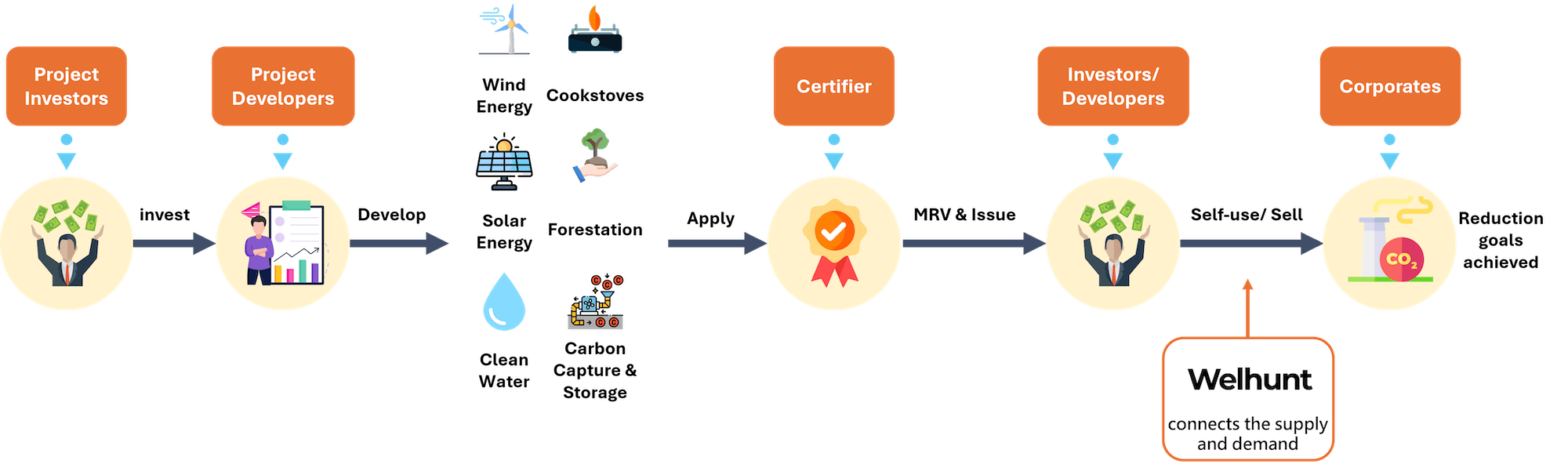
▲ Lifecycle of Carbon Credit
Use for Carbon Credit
Carbon credit is a valuable tool in the fight against climate change, in combination with concrete actions to reduce emissions. In general, the use scenario for carbon credit can be categorized into either compliance purposes or voluntary purposes. Compliance purposes refer to those requirements from governmental authorities or other institutions with enforcement, including the Carbon Offsetting and Reduction Scheme for International Aviation (CORSIA) initiated by International Civil Aviation Organization (ICAO), carbon tax or carbon fees that allow a certain portion of the compulsory payment be offset by qualified carbon credits, like Singapore, South Korea, and Taiwan allow offsetting 5% emissions and Vietnam allows 30%.
Compliance Use
- CORSIA
- Carbon Tax Offset (e.g. Singapore, Vietnam, South Korea)
- Carbon Fees Offset (e.g. Taiwan)
Voluntary Use
- Carbon Neutrality Accredition (Organization/ Products/ Service)
- Supply Chain Requirement (e.g. Apple 100% carbon neutral supply chain)
- Voluntarily Determined Climate Goals
Below is an illustration of how corporates use carbon credit in general. To start, corporates usually do the GHG inventory to understand their status quo of emissions, based on which they will set their reduction goals and the strategies to reach the goals. And usually, corporates will have concrete action plans to reduce their emissions; while for those hard-to-abate emissions, carbon credits will be used to offset the residual emissions to realize corporates’ carbon goals.
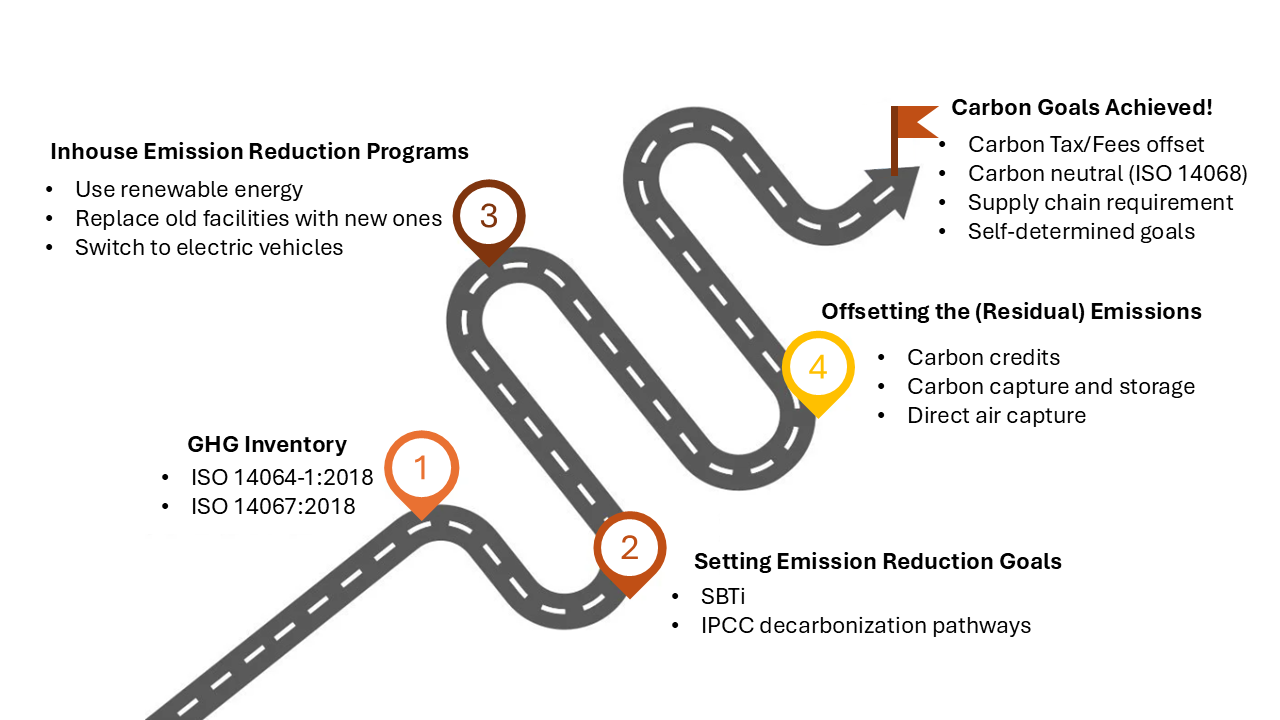
▲ Carbon Credits Use Scenario